
Transformer Removal and Decommissioning
Nationwide transformer removal and decommissioning. We de-install, rig, haul and document — all freight and rigging at our cost, and we pay you for the equipment. 954-740-1983.
| Payment timing | Upfront, in full, before loading |
|---|---|
| Payment method | Wire, ACH or certified check |
| Testing required | None — nameplate pricing |
| Offer contingencies | None beyond nameplate accuracy |
| Freight | Our cost |
| Rigging & crane | Our cost |
| Permits & escorts | Our cost |
| Pad restoration | Broom-clean, bolts cut flush |
Scope: What We Bring and What We Cover
Lift equipment matched to the unit
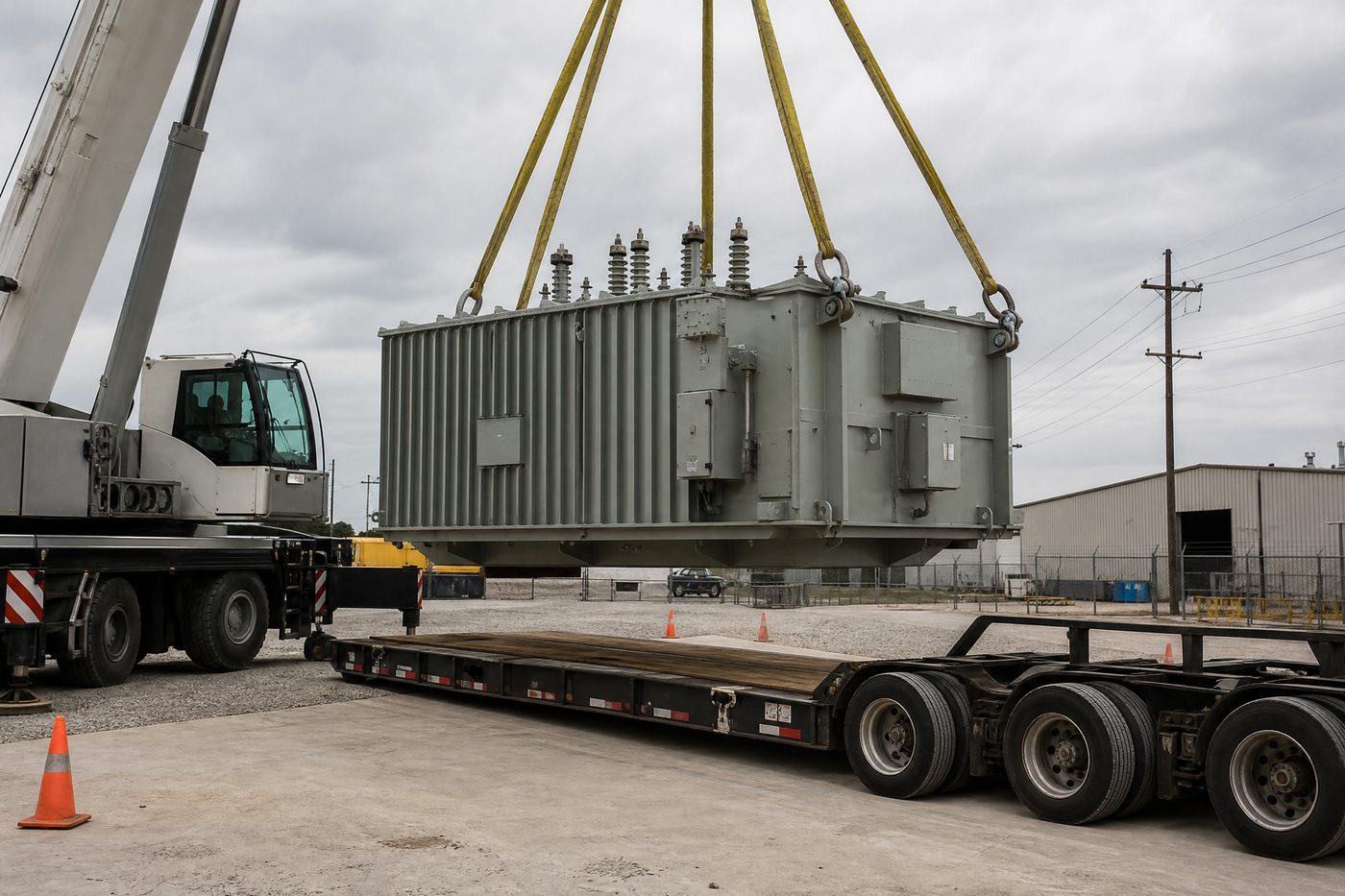
Removals are scoped from your photographs before anyone mobilizes, so the crew arrives with the right gear instead of improvising. A padmount typically means a boom truck or rough-terrain forklift. An indoor dry-type means machine skates, stair gear and sometimes door-frame removal or wall coring. Station-class equipment means a hydraulic crane, a multi-axle lowboy, a route survey and a permit package.
Permits, escorts and street occupancy
Oversize and overweight permits, street-occupancy permits, police details and escort vehicles are part of our scope. In dense downtown locations we plan night and weekend windows as standard rather than as an upcharge, because that is often the only way to get a crane set up without shutting a street during business hours.
Oil handling and containment
Spill containment is sized to the unit's actual oil volume and deployed before the unit is broken loose. Where fluid must be drained on site we handle it under containment with licensed transport and disposal, including PCB-suspect fluid. Our insurance certificates name your entity and are sent in advance.
Pad restoration and site condition
Conduit is cut and capped, the unit is broken loose from its pad or anchors, anchor bolts are cut flush and the pad is left broom-clean. Where a concrete pad must come out entirely we will quote that separately and honestly rather than folding a vague allowance into the equipment number.
Decommissioning Sequence and Responsibilities
Your side of the line
The unit must be de-energized, disconnected and locked out by a qualified electrician or the serving utility, and site access must be available during the agreed window. That work belongs to whoever holds the service and we do not price around it.
Our side of the line
Everything downstream of the disconnect: breaking the unit loose, rigging, lifting, loading, tie-down, permits, escorts, hauling and final disposition, plus the payment that goes out before any of it starts. You receive a net number for the equipment and are not invoiced for any part of the removal.
Working to a demolition or outage schedule
Most decommissioning work is date-driven, so we plan backwards from your date. For multi-unit sites we phase removals to follow your de-energization sequence rather than requiring the whole lineup to come out at once, and we can work nights, weekends and planned outage windows. If a date is tight, lead with it.
Multi-unit and full-lineup projects
Complete unit substations, switchgear lineups with attached transformer sections, and full substation yards are routine. Where a unit cannot leave in one piece we disassemble on site — radiators, conservators, bushings and accessories removed and crated, main tank rigged separately.
Equipment We Buy
Padmount Transformers
Pad-mounted distribution transformers are the single most liquid item we buy. A dead-front loop-feed unit in the 75 to 2500 kVA range with a legible nameplate and a sound tank can be priced from photographs the same day.
75 kVA – 5000 kVA300+ oil-filled units purchased annuallyOil-Filled Transformers
Liquid-filled units — mineral oil, silicone or ester — from 25 kVA pole-mounts up to 20 MVA power transformers. Oil is not a problem for us; containment, testing and disposal are part of what we do.
25 kVA – 20 MVA120–160 dry-type units handled per yearDry-Type Transformers
Ventilated, sealed and cast-coil dry-type units from 15 kVA control transformers up to 5000 kVA unit substation sections. Copper-wound units carry a materially higher offer than aluminum.
15 kVA – 5000 kVA40–60 substation-class units per yearSubstation Transformers
Station-class and power transformers from 1 MVA to 100 MVA, including units with load tap changers, radiator banks and conservator tanks. These are heavy-haul projects and we run them end to end.
1 MVA – 100 MVALots of 10 to 400 units purchased at a timePole-Mount Transformers
Single-phase and three-phase overhead distribution transformers, 5 kVA to 500 kVA. This is a volume item — we buy them by the pallet and by the trailer load out of utility and co-op surplus programs.
5 kVA – 500 kVA25–40 complete lineups per yearUnit Substations
Complete primary-transformer-secondary lineups: incoming section, transformer, and low-voltage switchgear or switchboard bolted as one assembly. We buy them whole and we buy them by the section.
300 kVA – 5000 kVAReady for a number?
Send the nameplate. Payment upfront before loading, no testing required, freight and rigging covered in all fifty states.